


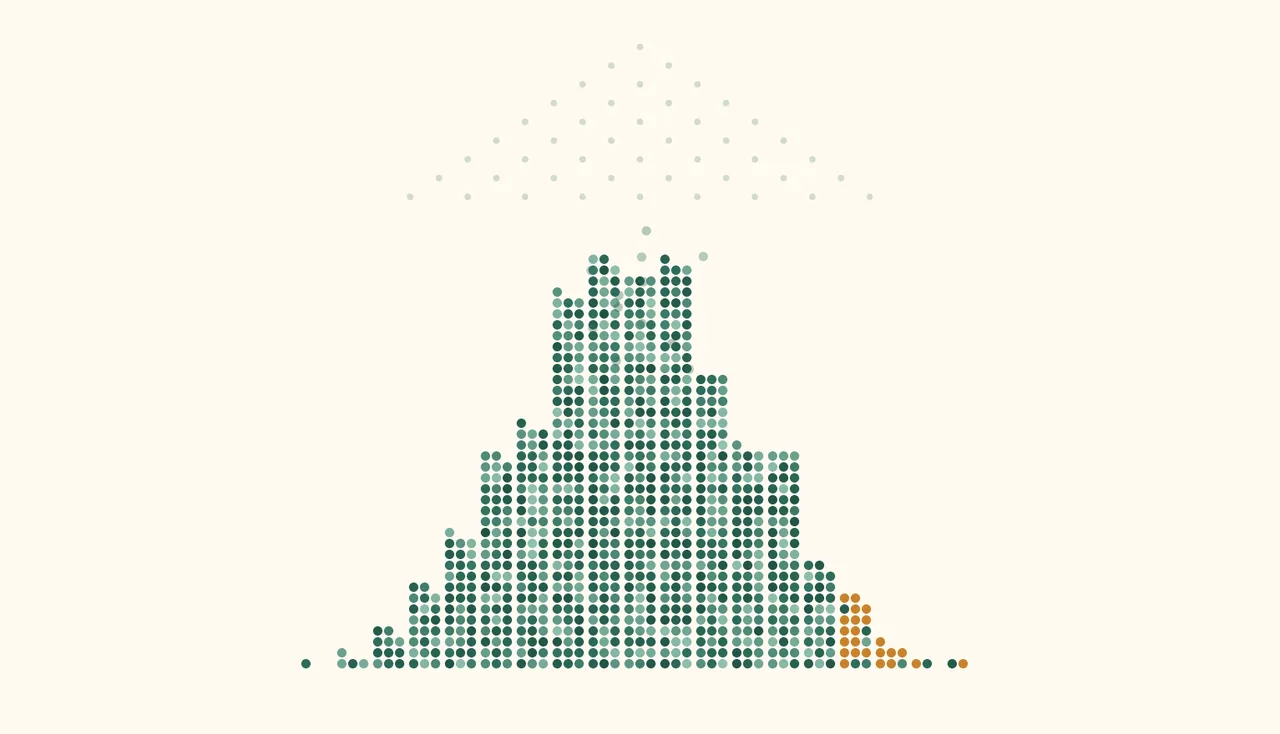
For decades, researchers hoped to find "the gene for" schizophrenia, depression or ADHD. That gene does not exist. The largest genetic studies ever run in psychiatry show instead that risk for most mental health conditions is spread across thousands of small genetic differences, each nudging risk up or down by a tiny amount. Geneticists call this polygenic risk: many genes, each with a small effect. This article explains how that picture was built, what it reveals about the brain, and why a polygenic score is not a test to order for a client.
Heritable, but not in the way people expect
Twin and family studies showed long ago that genes matter. Schizophrenia and bipolar disorder each have an estimated heritability of 60 to 80 percent (Trubetskoy and colleagues, 2022; O'Connell and colleagues, 2025), and major depression about 37 percent (Adams and colleagues, 2025).
Heritability is easy to misread. It describes how much of the difference between people in a population traces back to genetic differences. It does not mean that 80 percent of one person's illness is "genetic", and it does not mean a condition is fixed or untreatable. What heritability could not say was which genes were involved, or how many. That answer came only when researchers pooled DNA from hundreds of thousands of people.
How the risk variants are found
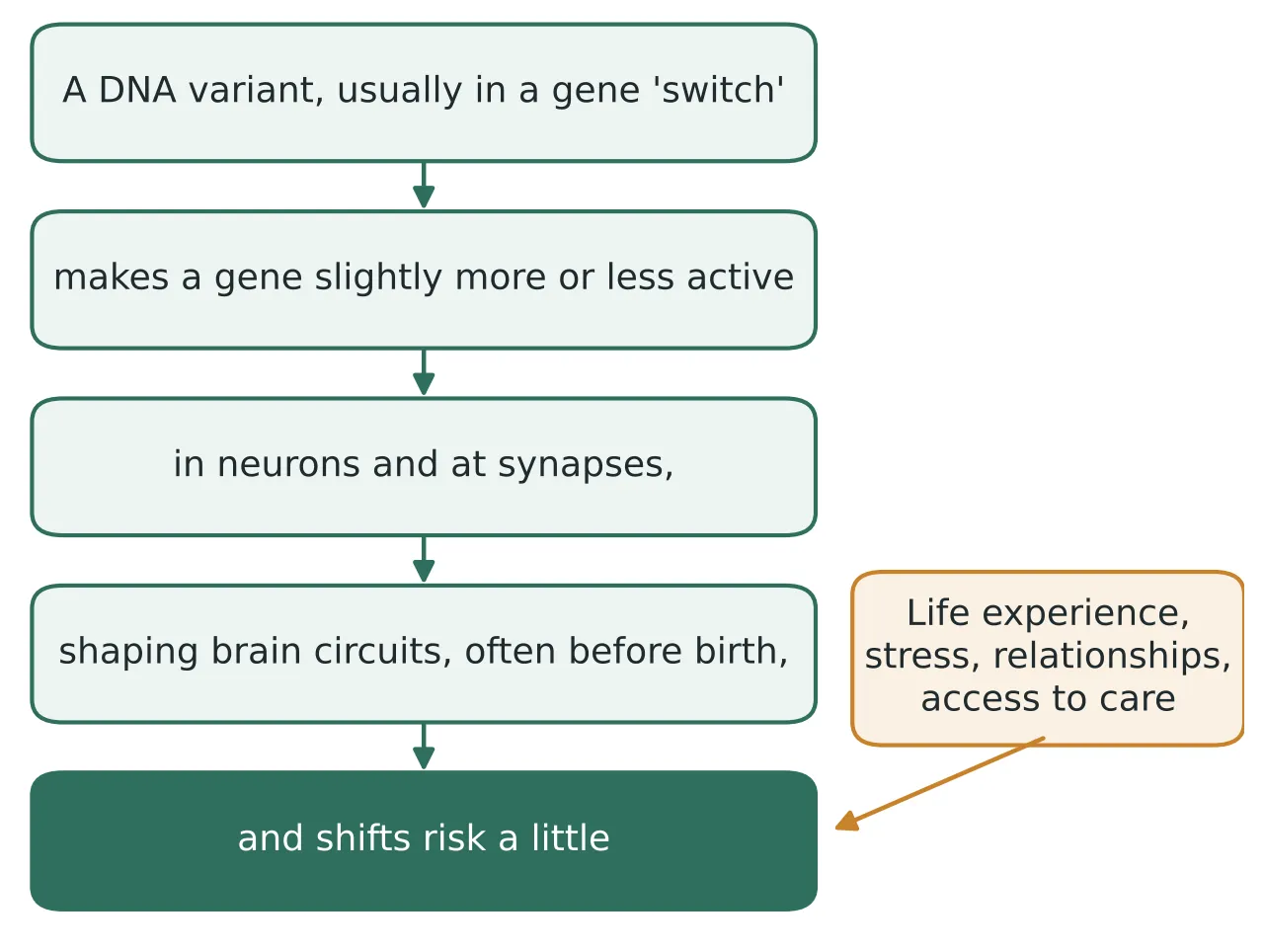
The main tool is the genome-wide association study, or GWAS. Researchers compare millions of common DNA variants between people with a condition and people without it, and flag the places in the genome where a variant is slightly more common in the first group. Each flagged region is called a locus. Most of these variants sit outside the genes themselves, in stretches of DNA that work like dimmer switches, turning nearby genes up or down in particular cells.
The effects are tiny, so the studies have to be enormous. The Psychiatric Genomics Consortium, an international collaboration of hundreds of research groups, pools samples condition by condition. Its most recent results:
- - Schizophrenia. 287 loci, from up to 76,755 people with schizophrenia and 243,649 without (Trubetskoy and colleagues, 2022).
- - Depression. 635 loci, from 688,808 people with major depression and more than 4.3 million controls in 29 countries (Adams and colleagues, 2025).
- - Bipolar disorder. 298 loci, from 158,036 people with bipolar disorder and about 2.8 million controls (O'Connell and colleagues, 2025).
- - ADHD. 27 loci, from 38,691 people with ADHD and 186,843 controls (Demontis and colleagues, 2023).
- - Autism. 5 loci, from 18,381 autistic people and 27,969 controls: the first common variants robustly linked to autism (Grove and colleagues, 2019).
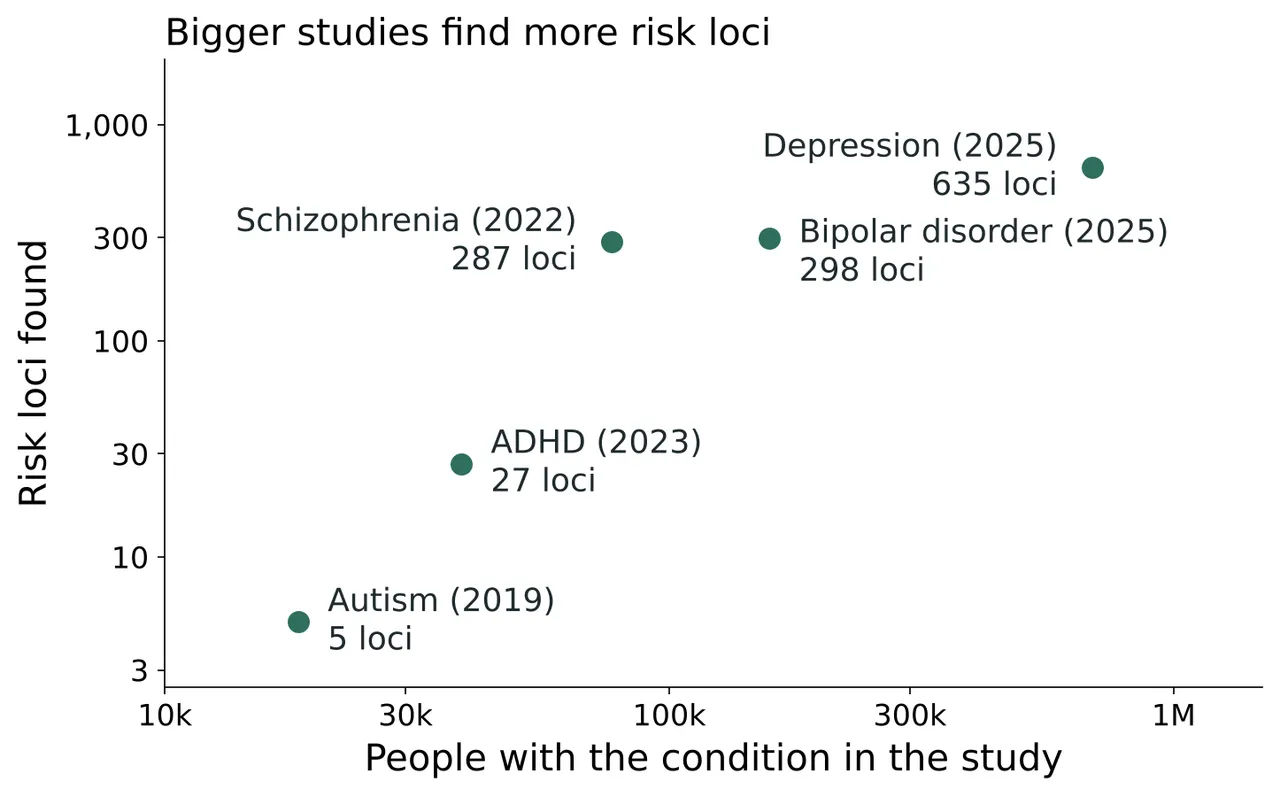
Much of the gap between conditions reflects study size rather than biology. Autism's five loci came from a sample less than a thirtieth the size of the depression study's. And the variants found so far are only the tip: the ADHD study estimated that about 7,300 common variants account for 90 percent of the heritability its data could capture (Demontis and colleagues, 2023), far more than the 27 it could name.
Rare variants with large effects
Common variants are only part of the story. A much smaller set of rare genetic changes carries far larger effects. Some are missing or duplicated stretches of DNA, called copy number variants. The best known, a deletion on chromosome 22 at a spot called 22q11.2, makes schizophrenia dramatically more common among the people who carry it (Singh and colleagues, 2022).
By sequencing the protein-coding DNA of 24,248 people with schizophrenia and 97,322 without, the SCHEMA consortium found ultra-rare damaging changes in 10 genes that raise the odds of schizophrenia by roughly 3 to 50 times (Singh and colleagues, 2022). Two of those genes, GRIN2A and GRIA3, build receptors for glutamate, the brain's main excitatory messenger. Because these changes are so rare, they account for only a small share of schizophrenia across the population, even though they matter a great deal to the few families who carry them.
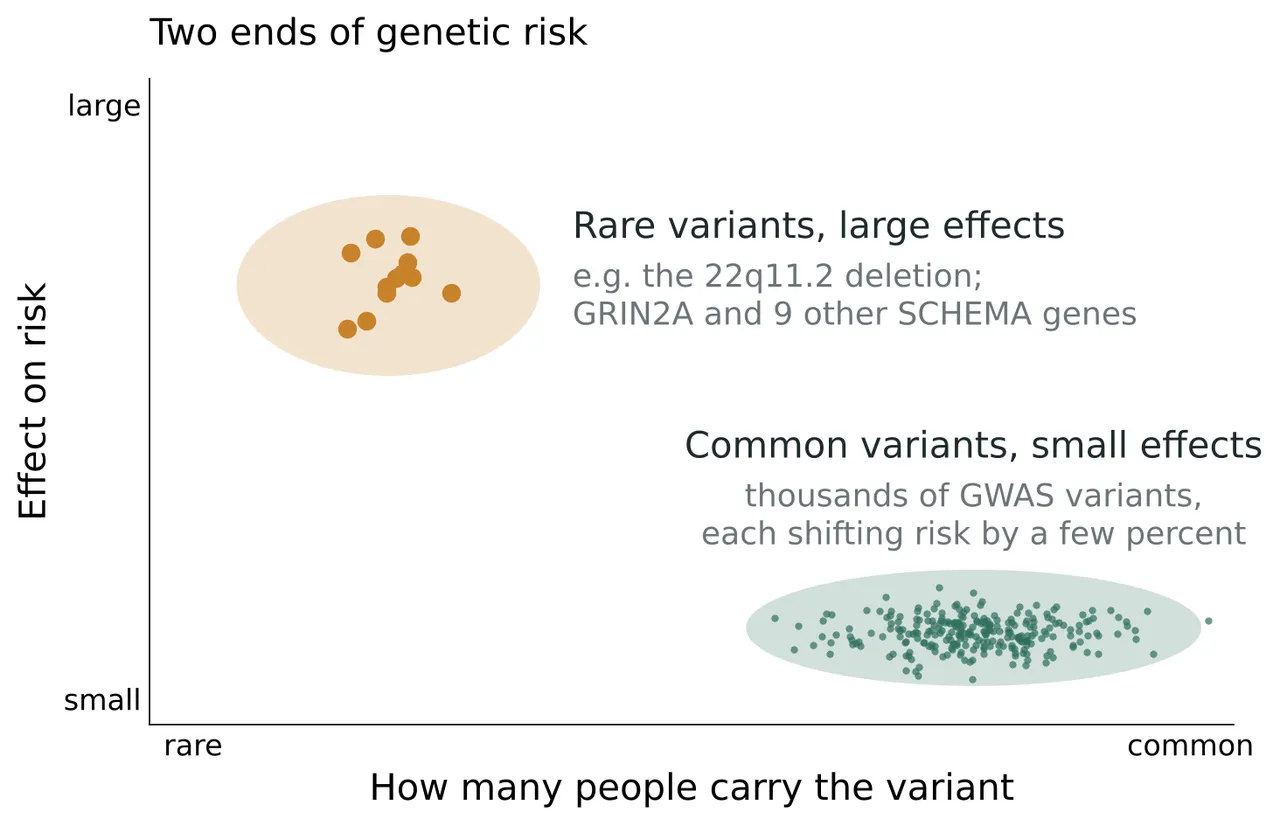
The two kinds of risk point the same way. Genes singled out by the common-variant studies also carry an excess of rare damaging changes in people with the condition, for schizophrenia (Trubetskoy and colleagues, 2022) and for bipolar disorder (O'Connell and colleagues, 2025). GRIN2A, for example, turns up in both kinds of study. That convergence is one reason researchers trust the genes these studies name.
What the genes point to in the brain
The most useful thing these studies have delivered so far is not prediction but biology. When researchers ask where in the body the risk genes are most active, the answer for psychiatric conditions is consistent: in the brain, and mostly in neurons.
- - Neurons and synapses. Schizophrenia risk was concentrated in genes expressed in the brain's excitatory and inhibitory neurons, with little sign of enrichment in glial cells. The gene groups that stood out all related to how neurons work, especially the receiving side of the synapse (Trubetskoy and colleagues, 2022).
- - Particular circuits. Depression risk pointed to excitatory neurons in the amygdala, hippocampus and cortex, and to the medium spiny neurons of the striatum, a hub for reward and motivation (Adams and colleagues, 2025). Bipolar disorder pointed to inhibitory interneurons in the prefrontal cortex and hippocampus and, again, to medium spiny neurons (O'Connell and colleagues, 2025). ADHD risk was enriched in genes active in the frontal cortex and in the dopamine-making neurons of the midbrain (Demontis and colleagues, 2023).
- - The brain before birth. Genes linked to autism were most active while the cerebral cortex forms in the fetus (Grove and colleagues, 2019). ADHD's top genes were enriched for genes active in early embryonic brain development (Demontis and colleagues, 2023). And in the broadest cross-condition analysis so far, the genes behind shared risk were most active at fetal stages and in early life (Grotzinger and colleagues, 2025).
- - Existing medicines. Depression's risk genes were enriched for the targets of antidepressants already in use, which suggests the genetic map can help find new treatments or new uses for old ones (Adams and colleagues, 2025).
A closer look: C4 and synaptic pruning
One finding shows how a single locus can be traced to a mechanism. Schizophrenia's strongest common-variant signal sits in an immune region of chromosome 6. In 2016, Sekar and colleagues showed that much of it comes from the many structural forms of a gene called C4, part of the complement system the body uses to tag things for removal (Sekar and colleagues, 2016).
Forms of the gene that produce more of the C4A protein raised schizophrenia risk modestly, by up to about 27 percent. In brain tissue from people with schizophrenia, the C4A gene was about 1.4 times as active as in tissue from people without it, across all five regions tested. In mice, C4 was needed for the normal pruning of synapses during development. Together these results suggest that excess complement activity may help explain why the brains of people with schizophrenia show fewer synapses (Sekar and colleagues, 2016).
The C4 story is still partial. It explains part of one locus out of hundreds, and mice do not have the human split into C4A and C4B, so the animal results cannot be carried over directly. But it is a model of what the field hopes to do for many more loci: go from a statistical signal to a gene, a cell and a process.
One genome, many diagnoses
Genetics does not respect diagnostic boundaries. In the third cross-disorder study of the Psychiatric Genomics Consortium, Grotzinger and colleagues analysed 14 conditions, with more than a million cases in total. Five broad genetic factors explained, on average, about two-thirds of each condition's genetic variance (Grotzinger and colleagues, 2025):
- - Compulsive: anorexia nervosa and OCD, with smaller contributions from Tourette syndrome and anxiety.
- - Psychotic and mood: schizophrenia and bipolar disorder.
- - Neurodevelopmental: autism and ADHD, with a smaller contribution from Tourette syndrome.
- - Internalizing: depression, anxiety and PTSD.
- - Substance use: alcohol, nicotine, cannabis and opioid use disorders, with a smaller contribution from ADHD.
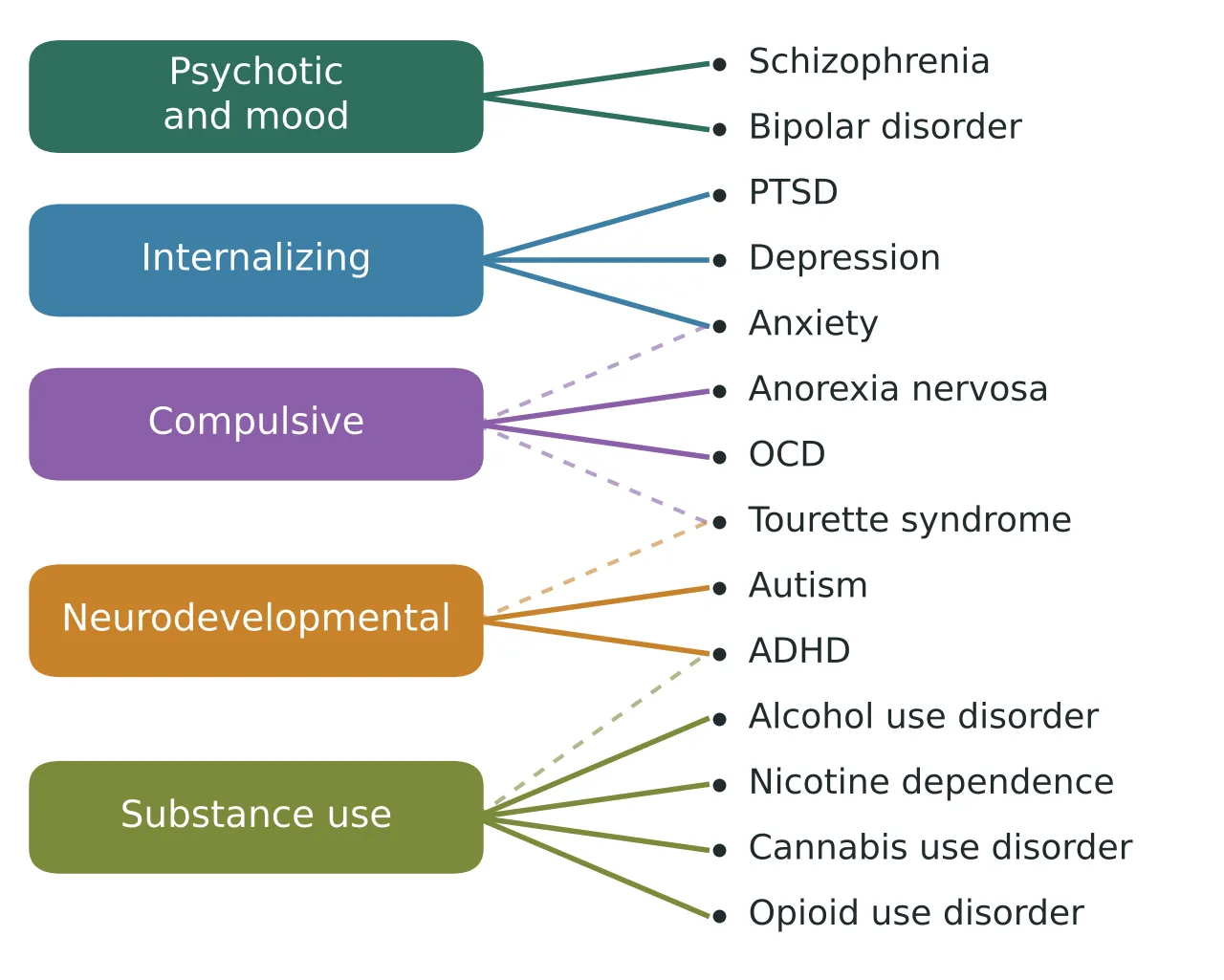
The study found 238 loci that act across several conditions at once. The shared risk of schizophrenia and bipolar disorder was concentrated in genes of excitatory neurons, while the internalizing factor was tied to oligodendrocytes, the cells that insulate nerve fibres (Grotzinger and colleagues, 2025). The ADHD study reached a similar conclusion from another direction: an estimated 84 to 98 percent of the variants that influence ADHD also influence other psychiatric conditions, though not always in the same direction (Demontis and colleagues, 2023).
For clinicians, this fits everyday experience: comorbidity is common, and presentations shift over a lifetime. The genetics suggests that much of this overlap reflects shared biology rather than diagnostic noise. The authors argue that their results bear directly on long-running debates about where diagnostic lines should fall, for example between schizophrenia and bipolar disorder. They also note that shared biology could point to treatments for conditions that often occur together, as SSRIs already help across several diagnoses.
Polygenic scores: what they can and cannot do
A polygenic score (also called a polygenic risk score, or PRS) adds up the risk variants a person carries, each weighted by its effect in a GWAS, into a single number. It is cheap to compute from a saliva or blood sample, and in research it is a powerful tool. In the clinic, for mental health conditions, it is still weak. There are four reasons.
- - It explains little. Among people of European ancestry, the best schizophrenia score explains about 7 percent of the variation in liability (Trubetskoy and colleagues, 2022). The newest depression score explains about 6 percent (Adams and colleagues, 2025), and the bipolar disorder score about 9 percent (O'Connell and colleagues, 2025).
- - People with and without the condition overlap. A common measure of how well a test separates two groups, the AUC, runs from 0.5 (a coin toss) to 1 (perfect). Even for schizophrenia, the score reaches only about 0.72 (Trubetskoy and colleagues, 2022); for depression it is about 0.63 (Adams and colleagues, 2025).
- - It works worst for most of the world. About 79 percent of GWAS participants are of European descent. Across 17 traits, scores built from those studies predicted 2.5 times less well in people of East Asian ancestry and 4.9 times less well in people of African ancestry (Martin and colleagues, 2019). In the depression study, the score was not associated with depression at all in the large African-ancestry sample of the US Million Veteran Program (Adams and colleagues, 2025).
- - A number is easy to misread. A percentile on its own says little about a person's lifetime risk, and presenting a score as a verdict can harm wellbeing and life choices (Lewis and Vassos, 2020).
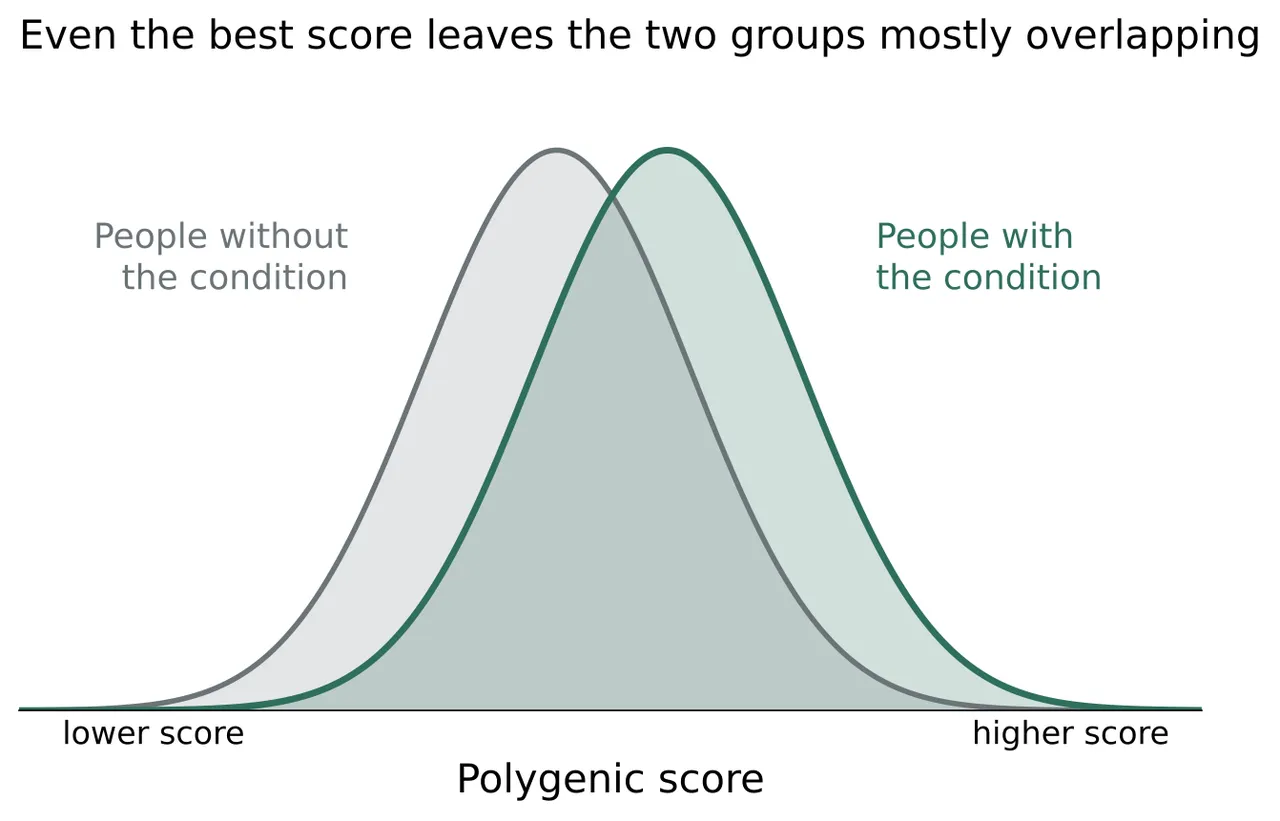
Take depression. People in the top tenth of the depression score had about five times the odds of depression of people in the bottom tenth (Adams and colleagues, 2025). That sounds large. But in a simple model built on the study's own figures, with a lifetime risk of 15 percent, about three in four people in that top tenth would never develop depression, and about four in five people who do develop it would have a score outside the top tenth.
an indicator, not a precise measure
Scores may become more useful where the chance of a condition is already high. In people with a first episode of psychosis, a schizophrenia score helped separate those later diagnosed with schizophrenia from those with other psychoses; people in the top fifth had about twice the risk of a later schizophrenia diagnosis (Lewis and Vassos, 2020). That is a research finding, not a test in routine use.
The same caution applies to embryo screening by polygenic score, which some fertility companies now sell. Embryos from the same two parents vary much less in their scores than unrelated adults do, so the expected benefit shrinks. And because the same variants touch several traits, selecting for one can raise the risk of another: in one worked example, choosing embryos for higher predicted educational attainment raised the risk of bipolar disorder by about 16 percent in relative terms (Turley and colleagues, 2021).
Genes are not destiny
Polygenic risk is a matter of probability. Even for schizophrenia, one of the most heritable conditions, common variants together account for only about a quarter of the variation in liability (Singh and colleagues, 2022). For depression, with a heritability of about 37 percent, close to two-thirds of the variation lies in factors other than genes (Adams and colleagues, 2025). Life experience, relationships, stress, substance use and access to care all shape who becomes unwell and who recovers.
The research also shows how much diagnosis itself shapes the genetics. In the bipolar disorder study, samples recruited from clinics carried a clearly stronger genetic signal than samples from community surveys or self-report, and bipolar I and bipolar II differed in which other conditions they resembled genetically (O'Connell and colleagues, 2025). In autism, the genetic picture differed across subgroups, for example between autistic people with and without intellectual disability (Grove and colleagues, 2019). A diagnosis groups people with real differences, and the genes reflect that.
What this means in the therapy room
Most therapists will never order a genetic test, but clients ask about genes often: after a parent's diagnosis, when starting a family, or after a consumer DNA report. A few practical points:
- - Talk about risk, not fate. When a client asks whether they "inherited" a condition, an honest answer is that many small genetic factors raise or lower risk a little, alongside life experience, and that none of them decides the outcome on its own.
- - Treat consumer scores with care. If a client brings a polygenic score from a consumer test, help them see it as a rough indicator with wide uncertainty, especially if their ancestry is not European. Questions about what it means medically belong with a genetic counsellor or physician.
- - Know where genetics already matters. Rare, large-effect findings, such as a known 22q11.2 deletion in a family, are a matter for medical genetics, not for a polygenic score.
- - Use the science to ease blame. For many families, learning that risk comes from thousands of small, shared variants, and that genes are only part of the picture, may lighten guilt and stigma.
- - Record family history as facts. Who, which diagnosis, at what age, and what helped. Clear, factual notes keep family history useful for treatment planning and for any later referral.
This article is general information for clinicians. It is not clinical, genetic or legal advice.